Custom ERP or CRM, or One Off the Shelf
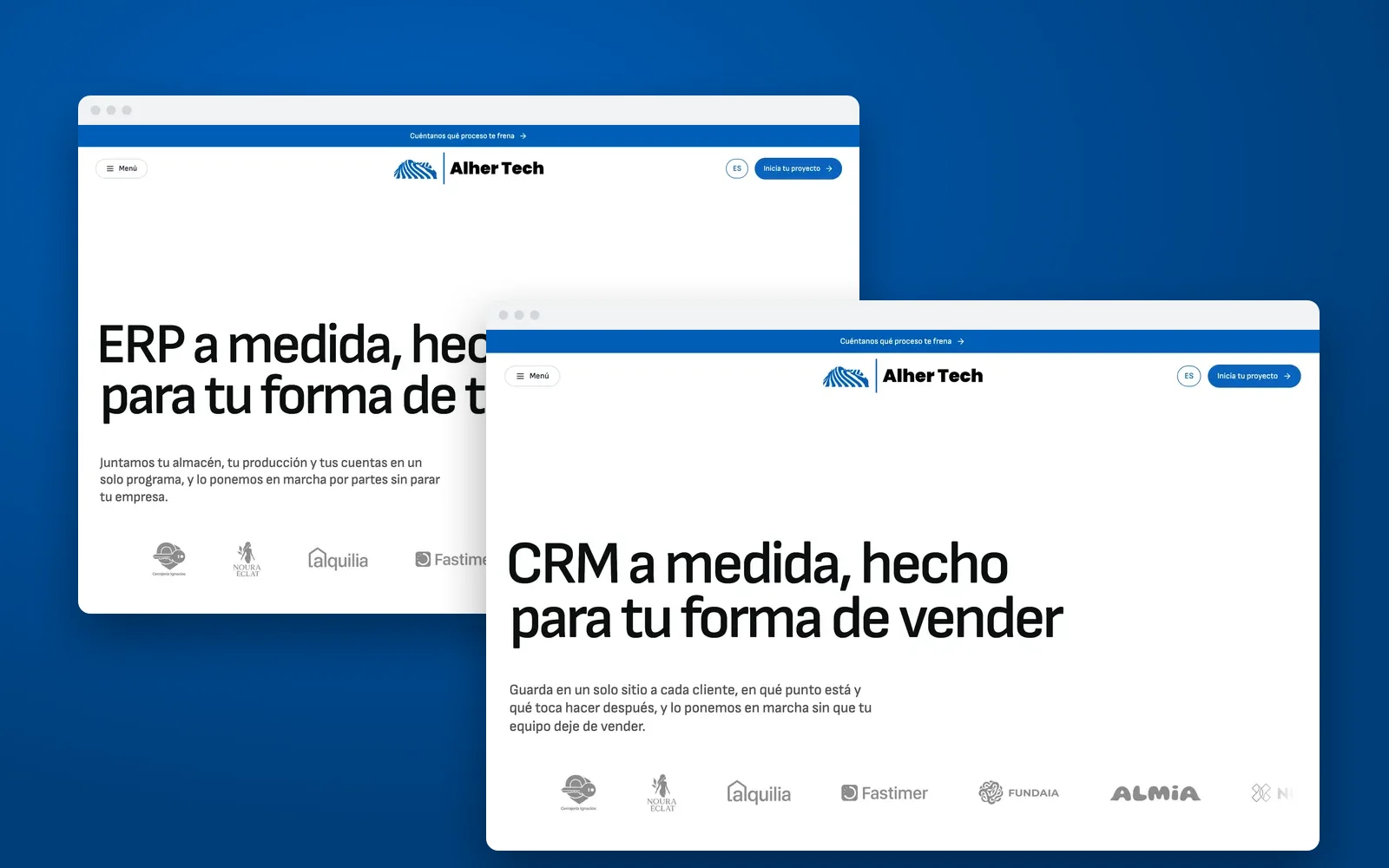
If an off-the-shelf one fits you, it is the quickest and simplest option.
If an off-the-shelf one fits you, it is the quickest and simplest option.
Custom pays off when the way you work is exactly what that software cannot do, and often the best answer is both together. Off the shelf for what is the same in every company, and custom for what is only yours, connected to the rest. I write this as one of the two partners who build Alher Tech's projects, from what we see on every first call.
An ERP is the software where a company runs its day to day, from the order to the warehouse, the invoice and the accounts. A CRM is where it keeps its customers, where each sale stands and what to do next.
An off-the-shelf one is software that already exists and that many companies use at once, such as Odoo for running the business or HubSpot and Pipedrive for sales. You set it up, pay a fee, usually for each person who uses it, and whoever sells it maintains it and keeps it up to date.
A custom one is built for your company. It does what your team does, the way it does it, and the software, its code and your data are yours. You pay to have it built and, if you want, to have it looked after, not a licence per person.
And there is a third way, the one we see most. Keep off the shelf what is the same in every company and build only what is yours, connected to what you already use.
| Off the shelf | Custom | |
|---|---|---|
| When you start using it | As soon as you set it up | In parts, each one as soon as it is ready |
| What it does | What most companies do. Yours, with tweaks or by hand | What your team does, with its own steps |
| What you pay | A fee that usually grows with each person and each module | What it costs to build and, if you want, to look after. It does not grow with the team |
| Who maintains it | Whoever sells it, for all their customers at once | Whoever builds it, or your team if you prefer |
| Changes | The ones the vendor decides | The ones you ask for |
| Whose it is | The software is the vendor's. You can take your data out | The software, its code and your data are yours |
| If you change provider | You take your data and start again in another program | You take the whole software with you and someone else can carry it on |
When what you do is what almost everyone does. If you sell, invoice and run your warehouse like most companies in your sector, off-the-shelf software already does it well, you have it running sooner and you do not have to think about maintaining it. It is especially enough if any of these apply.
In those cases we tell you on the first call, and nothing needs to be built. Our custom ERP and custom CRM pages say so too.
One sign alone is not enough to switch. When several come together, it is worth checking whether a custom part saves you more than it costs. At Leaderbrock, a sports marketing agency with sales reps in several countries, the schedules lived in a spreadsheet and the receipts were on paper. We built that team's tool, with the app, the office panel and the server.
Some parts are the same in every company and also follow rules that change with the law. There, off-the-shelf software has the edge, because it is updated for all its customers at once.
The rest, what your team does in a way that is only yours, is where custom pays off, connected to that software. At Leaderbrock, finance approves the expenses in the tool we built and downloads them for Excel or for their accounting, which they still keep in their own software. And for a client with stores in two chains we built only the part that receives the goods, Almacén-Pro. The worker uploads the delivery note and checks each product with the scanner, also with no signal. It is not a whole ERP, just one part built to measure.
Alquilia is an example. It is a CRM for rental agencies that answers anyone who asks about a flat over WhatsApp, asks for their documents and gives them a score, so the agency only spends its time on those who qualify. We built all of it, around that way of working.
We do not give a price or a timeline without seeing your case, because they depend on these things, and we give them to you in writing before we start.
How many people use it changes little in a custom one and a lot in an off-the-shelf one, which charges for each of them.
No. If we build it, we can keep looking after it, and if you would rather your team runs it, we walk them through it. With an off-the-shelf one you do not either, although someone has to set it up and keep up with its changes.
Not quite. Setting it up is choosing among what the software already has. When that is not enough, pieces are added on top, and an update from the vendor can break them. At that point, a custom part connected to it causes fewer problems than off-the-shelf software forced too far.
It is the most common case, and what was done is not lost. What works stays in it, and only what is missing is built custom. Or its data is moved into the new software.
It depends on what it involves, as above. After a first call, free of charge, we tell you in writing what it costs and how long it takes before we start.
Software · 7 min read · Oct 25, 2026
Two people press Book on the same time at once and the software says yes to both. How our own booking system stops it by letting the database turn down the second, what the software still checks first and why holding a time while someone pays is a different problem.
Case study · Nov 12, 2026
Fundaia is our platform for putting applications on the internet. You give it your GitHub repository and it builds it, starts it and leaves it at its own address, without you setting up any server. We built it ourselves, and this website's API runs on it.
Case study · Nov 12, 2026
Alquilia is a program for rental agencies that answers anyone who asks about a flat over WhatsApp. It picks up the people who come from the property portals, asks them the agency's questions, asks for their documents and gives them a score, so the agency only spends its time on those who qualify. We built all of it for Alquilia, from the website to the assistant.